What happens after you contact an emergency restoration company?
Property damage rarely happens at a convenient time. Water may be spreading through flooring, smoke odor may be moving into adjoining rooms or visible mold may indicate that materials have remained damp longer than expected.
In that moment, many property owners hesitate because they do not know what will happen after they call a restoration company. They may be concerned about authorizing work they do not understand, involving insurance too early or receiving an estimate before the complete damage is visible.
Contacting Service Pros Cleaning & Restoration begins a structured process. We collect information about the incident, identify immediate concerns, arrange the appropriate response and evaluate the property before developing the restoration scope.
You do not need to diagnose the damage before requesting help. Our role is to determine what has happened, which areas may be affected and what needs to occur first.
The first conversation focuses on the active problem
When you call or submit a restoration request, the first priority is understanding what is happening now. We may ask whether water is still flowing, whether the fire department has released the property, whether visible mold is present or whether an affected area contains sewage, smoke residue or unstable materials.
The purpose is not to prepare a final estimate over the phone. It is to understand the type of response required and provide appropriate guidance while the site visit is arranged.
Useful information includes where the damage occurred, when it was discovered, what may have caused it and whether the condition is still changing. You can also tell us if children, pets, tenants, employees or vulnerable occupants are present.
If you do not know the source or full extent, say so. Uncertainty is common during the first call and should not prevent you from requesting assistance.
Dealing with water, mold, fire, smoke or other property damage?
Request emergency restoration service from Service Pros
You do not need complete documentation before calling
Photographs, videos and information about the incident can be helpful, but gathering them should not delay urgent assistance.
If the area can be approached safely, take several photographs showing the source, affected surfaces and surrounding rooms. Avoid entering standing water, touching electrical equipment or moving through an area that may be structurally unstable or contaminated.
You may also have information from a plumber, fire department, building manager or another professional. Share what is available, but do not worry if written reports have not yet been provided. Service Pros can begin evaluating the restoration needs based on the conditions found at the property.
Emergency guidance depends on the type of damage
Different losses require different immediate decisions. A clean-water supply-line leak does not present the same conditions as a sewage backup. Smoke residue requires different handling from ordinary household dust. Suspected mold should not be disturbed without considering how particles may move into surrounding areas.
Our first guidance is therefore based on the information you provide and what can be established safely.
In many situations, the appropriate steps are to keep people away from the affected area, stop the source if this can be done safely and avoid moving contaminated or wet materials through unaffected rooms.
Do not begin removing walls, pulling up flooring or applying household chemicals simply to make the area look cleaner before the assessment. These actions can change the site conditions, spread contamination or make the original damage harder to document.
The response is matched to the urgency of the loss
Not every restoration request requires the same scheduling. Active flooding, standing water, fire damage, sewage or rapidly changing conditions may require an emergency response. A contained mold concern or a completed water loss with no active source may begin with a scheduled assessment.
During the initial conversation, we determine whether the property needs immediate mitigation or an evaluation that can be arranged according to normal scheduling.
Service Pros provides 24/7 emergency restoration support throughout Maryland, Washington, D.C., Virginia and surrounding communities. The response plan is based on the type of damage, its current condition and available property access.
If the situation is urgent, call rather than relying only on a non-emergency message.
The on-site assessment looks beyond the visible damage
The first visible stain or puddle does not always represent the complete affected area. Water can travel below flooring, through ceilings or behind baseboards. Smoke may reach rooms that were not directly exposed to flames. Mold can appear on one surface while moisture remains in adjoining materials.
During the assessment, we evaluate the source, affected areas, building materials, access and immediate safety concerns. Depending on the loss, the evaluation may also involve moisture readings, inspection of surrounding rooms or consideration of how air and water moved through the property.
The assessment helps us distinguish between work that should begin immediately and decisions that require additional information.
Water damage assessment
For water losses, we consider where the water originated, how long materials may have been exposed and where moisture may have traveled.
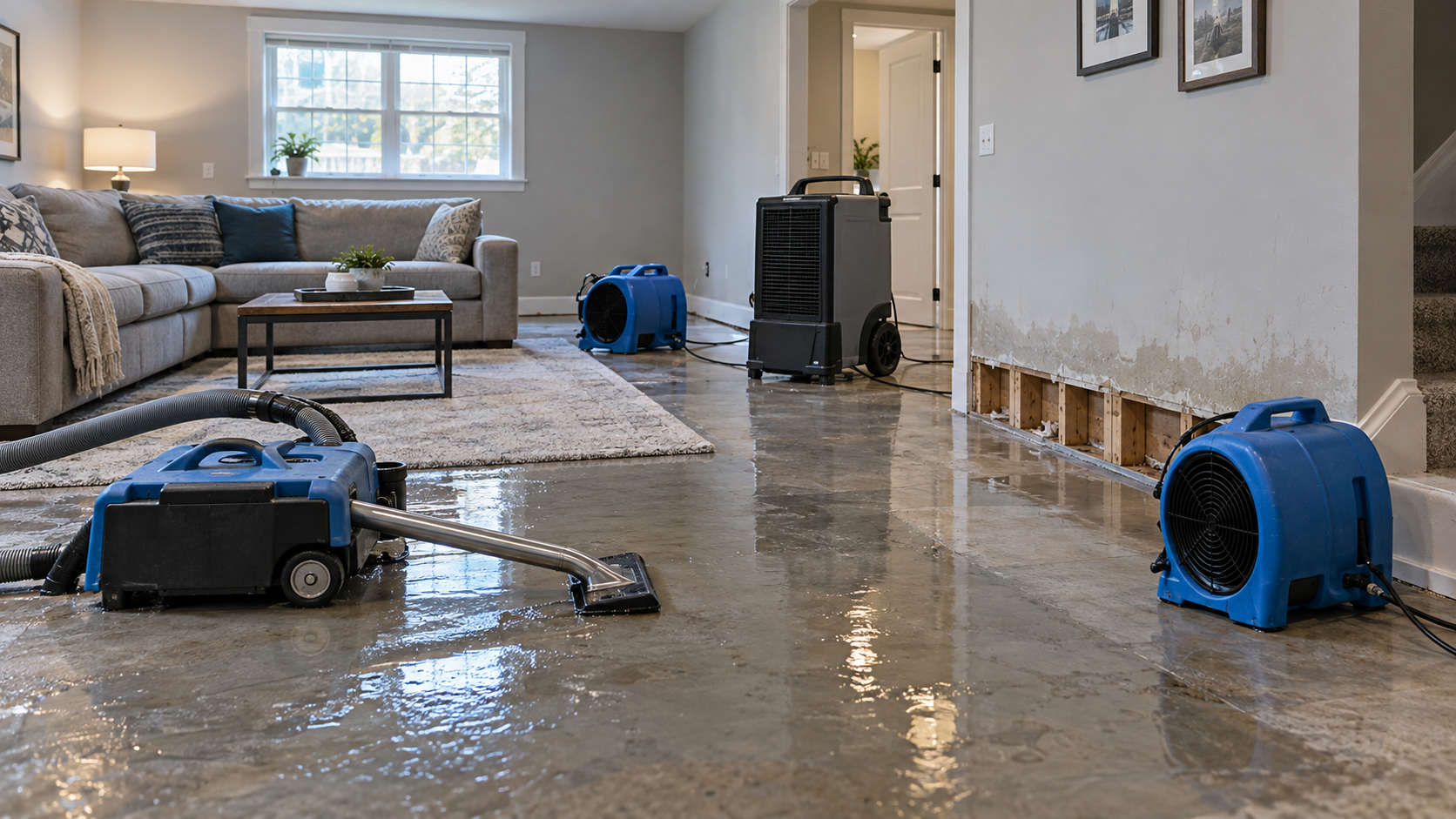
The initial plan may involve water extraction, moisture evaluation, structural drying, selective removal or continued monitoring.
Learn more about our water damage restoration services.
Mold assessment
For mold-related concerns, we consider the visible growth, surrounding materials, moisture conditions and the way the affected space is used.
The resulting plan may include containment, air filtration, removal of affected materials, cleaning, drying and coordination of the moisture source.
Review our professional mold remediation services.
Fire and smoke assessment
After a fire, we evaluate more than burned materials. Soot, smoke odor, firefighting water, damaged contents and openings created during emergency response can all influence the recovery plan.
The first phase may involve stabilization, smoke and soot cleanup, moisture control or contents decisions before reconstruction begins.
Explore fire damage restoration services.
Immediate mitigation may begin before the complete repair scope is known
Property damage can continue spreading while the final reconstruction plan is still being developed. For that reason, emergency mitigation may need to begin before every repair is priced. The objective is to control active damage, protect the property and establish more stable conditions.
This does not mean the entire project should become open-ended. The restoration team should explain what immediate work is recommended, why it is time-sensitive and who can authorize it. Additional conditions discovered during cleanup or removal should be documented and communicated before the scope expands whenever circumstances allow.
The final repair estimate may develop later, after damaged materials have been exposed and the property has been cleaned or dried sufficiently for accurate planning.
The proposed scope should explain the immediate priorities
After evaluating the property, the restoration company should explain what needs to happen first. The proposal may address extraction, drying, containment, cleaning, material removal, odor treatment, contents handling or temporary property protection. The specific combination depends on the type of loss and site conditions.
A useful scope identifies the affected work areas and principal responsibilities. It should not rely only on broad terms such as “cleanup” or “restoration” without explaining what those services mean for the property.
At Service Pros, we explain which conditions have been confirmed, which materials require further evaluation and where later repair decisions may be necessary.
This gives the property owner a practical basis for authorization rather than asking for approval without context.
Insurance notification and emergency response can happen in parallel
Property owners often ask whether they should call the insurance company or the restoration provider first.
In an active emergency, protecting people and limiting additional property damage are the immediate priorities. You can contact your insurance carrier while arranging the restoration response.
The carrier determines coverage according to the policy. Service Pros evaluates the property and documents the authorized restoration work.
We can provide photographs, measurements, moisture-related information, affected-area notes and service records that may support communication during the claim. We do not promise that a particular service will be covered.
Keep your claim number, carrier contact, adjuster information and policy-related correspondence together. Share the appropriate details with the project contact once they become available.
You should know who can authorize the work
Restoration decisions can become confusing when several people are involved. A homeowner, landlord, property manager, tenant, business owner and insurance representative may each receive information, but they do not necessarily have the same authority.
Identify the person authorized to approve emergency services, scope changes and repairs. That person should be reachable when a decision could affect the schedule or prevent additional damage.
Service Pros should also identify the person responsible for communicating arrival information, findings, project updates and documentation.
One clear decision path helps avoid contradictory directions and delays.
Cleanup, remediation and reconstruction are related but distinct
Restoration may involve several phases. Emergency mitigation controls the active loss. Remediation addresses conditions such as mold, contamination, soot or damaged materials. Reconstruction restores drywall, flooring, trim, cabinets, paint and other components removed or damaged during the incident.
Not every project requires all three phases. A small water incident may be resolved through drying and limited repairs. A larger loss may require removal, remediation and extensive rebuilding.
Service Pros can coordinate the transition from emergency response into remodeling and post-damage reconstruction when repairs are needed.
This continuity helps prevent a property from being cleaned and dried but left without a clear path toward normal use.
The project timeline depends on the conditions found
A restoration company should not promise one standard completion time before evaluating the property.
The schedule depends on the source, affected materials, contamination concerns, drying requirements, contents, access and repairs. Material availability, permits, inspections or separate trades can also affect reconstruction.
The team should instead explain the principal milestones. These may include stabilization, removal, cleaning, drying, reassessment, repair approval and final review.
Knowing the next milestone is more useful than receiving a completion date that does not account for conditions still hidden behind walls or flooring.
Changes should be documented rather than treated as surprises
Some damage remains concealed until authorized removal begins. Wet insulation, damaged subflooring, soot inside an enclosed space or mold behind a finished surface may not be visible during the initial assessment.
The possibility of concealed damage does not justify unexplained charges.
Before work begins, ask how new findings will be photographed, priced and approved. A change should identify the condition discovered, the recommended response and its effect on cost or schedule.
This process gives the owner control while allowing the restoration plan to respond to actual property conditions.
Communication should continue after the first visit
The restoration process should not become silent after equipment is installed or demolition begins. Property owners should receive updates about progress, significant findings and upcoming decisions. If moisture is being monitored, the team should explain how the affected materials are responding. If reconstruction will follow, finish selections and material availability may need to be discussed before mitigation ends.
At Service Pros, we believe good restoration work includes explaining what we found, what we are doing and what needs to happen next.
The owner should not have to guess whether the project is waiting on drying, authorization, insurance communication, material selection or another contractor.
The final review should connect completed work with remaining responsibilities
Project completion means more than removing equipment or finishing one service phase. The final review should compare the completed work with the approved scope. It should also identify any remaining repairs, specialized services or owner responsibilities.
If reconstruction is included, review the finished surfaces, transitions and documented changes. If another contractor will complete the next phase, confirm that the affected area is ready and clarify which information should be transferred.
Keep the estimate, photographs, approved changes, invoices and applicable warranty information together.
These records can help with insurance communication, later repairs and future property maintenance.
Why property owners contact Service Pros
Service Pros Cleaning & Restoration responds to water damage, flooding, mold, fire, smoke and the repairs that may be needed afterward.
We are a local, family-owned and veteran-owned restoration company serving Maryland, Washington, D.C., Virginia and surrounding communities. Our team provides 24/7 emergency support, property-specific assessments and coordinated restoration planning.
When you contact us, you do not need to know which equipment the property requires or whether a material can be saved. You only need to explain what happened and what you currently see.
We will evaluate the site, identify the immediate priorities and explain the recommended next steps.
You can also request restoration service online or use our contact form for a scheduled consultation.
Related restoration resources